PythonSparse interface
OpenSeesPy passes sparse matrix data to solver objects as memoryviews. Solvers in this package wrap those buffers with NumPy, assemble a backend sparse matrix, invoke the numerical routine, and write results in place.
Linear solve
OpenSees calls solver.solve(**kwargs).
Keyword arguments
index_ptr, indices, values
: CSR/CSC sparse structure and coefficients.
rhs, x
: Right-hand side and solution buffers. x is overwritten.
num_eqn, nnz
: Matrix order and number of nonzeros.
matrix_status
: One of 'STRUCTURE_CHANGED', 'COEFFICIENTS_CHANGED', 'UNCHANGED'.
storage_scheme
: 'CSR' or 'CSC'. Default is 'CSR'.
Returns
0 if the solve succeeded; a negative integer otherwise. Set debug=True on
the solver to re-raise the underlying exception.
Eigen solve
OpenSees calls solver.solve(**kwargs) for eigen analysis.
Additional keyword arguments: k_values, m_values, eigenvalues,
eigenvectors, num_modes, find_smallest.
Eigen solvers raise on failure; they do not return a status code.
formAp
Linear solvers implement formAp(**kwargs) to compute Ap = A @ p without a
full solve. OpenSees supplies read-only p and writable Ap.
Matrix status
OpenSees indicates how the system matrix changed since the previous solve:
STRUCTURE_CHANGED
: Rebuild the sparse matrix (new index structure).
COEFFICIENTS_CHANGED
: Update coefficients in place; sparsity pattern unchanged.
UNCHANGED
: Reuse the cached matrix. Direct solvers also reuse the LU factorization.
Serial OpenSeesPy and parallelism
These solvers work with serial OpenSeesPy — the standard build where the full
analysis pipeline runs on one process. That includes state determination, element
and nodal assembly, constraint handling, convergence tests, and the call into
PythonSparse with the assembled stiffness (and mass, for eigen).
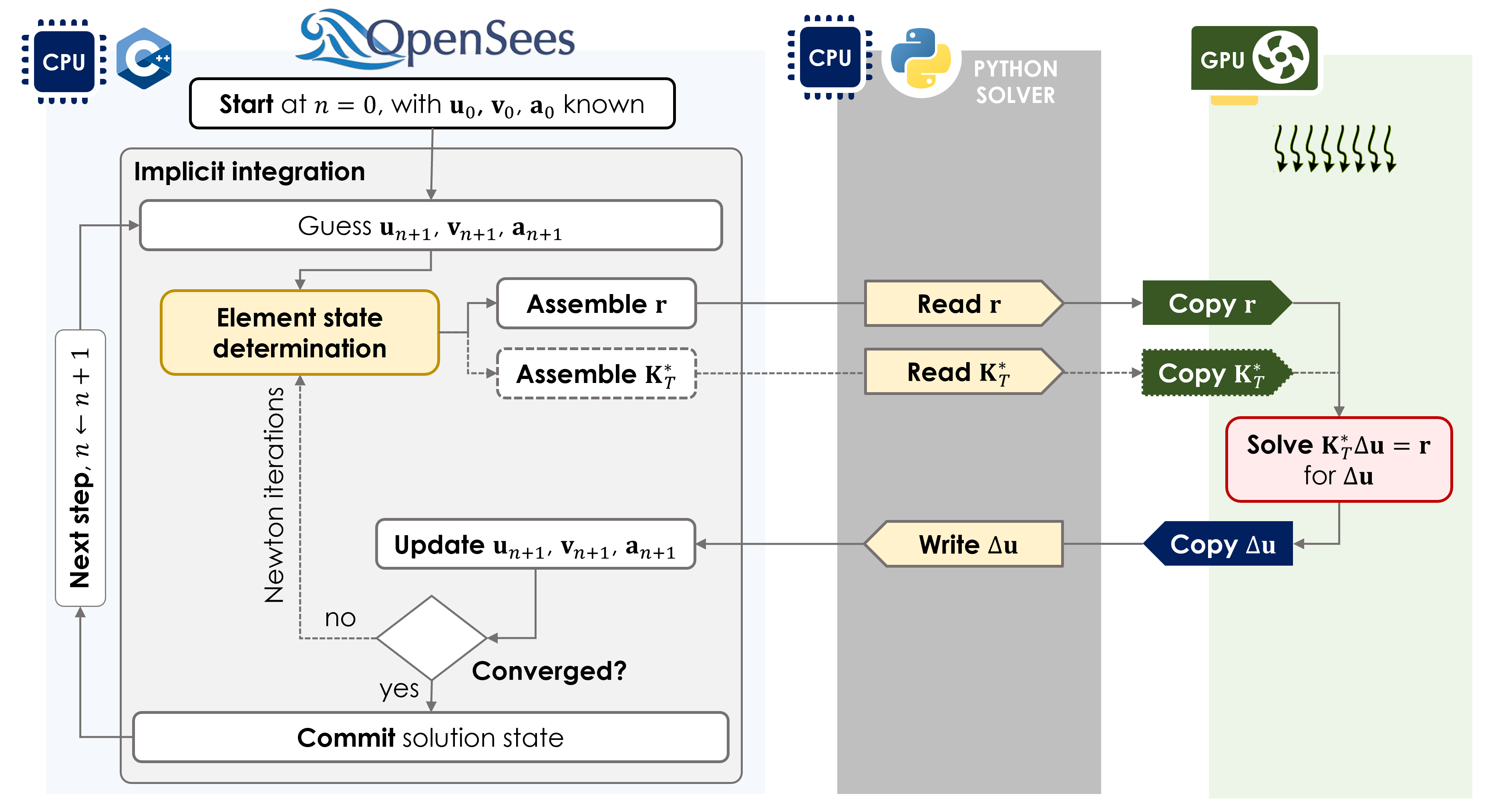
The diagram above is a typical nonlinear static/transient step with a GPU direct or iterative backend:
- OpenSees (CPU, C++) — Newton loop: element state determination, assemble residual
rand effective tangentK_T*, update displacements when converged. - Python solver (CPU, Python) —
PythonSparsecallback readsrandK_T*from OpenSees memoryviews, orchestrates the backend, writesΔuback. - GPU (optional) — copy
randK_T*host→device, solveK_T* Δu = r, copyΔudevice→host. scipy/UMFPACK paths stay on the CPU instead of the third column.
Eigen analysis follows the same split: OpenSees assembles K and M on the CPU; the solver object runs ARPACK, LOBPCG, or shift-invert on CPU and/or GPU depending on the solver constructor you choose.
This package does not support parallel or MPI OpenSeesPy builds where the model
is partitioned across processes. PythonSparse callbacks always run in the same
process that owns the model.
Where parallelism exists today
| Layer | Behavior |
|---|---|
| OpenSees model pipeline | Serial (single CPU process) |
scipy backends (spsolve, cg, eigsh, …) |
CPU linear algebra; may use multithreaded BLAS/LAPACK inside scipy/UMFPACK |
| cupy / nvmath backends | GPU factorization, iterative solve, or eigen iteration; matrix assembly still happens on the CPU in OpenSees, with host↔device transfers inside the solver |
So a GPU setup speeds up the sparse solve step, not domain decomposition or multi-rank OpenSees analysis.
See also
- User guide —
ops.system/ops.eigenusage for end users - Solver objects
- Adding a solver
- OpenSees PythonSparse documentation